Europe is not a monolith. In some countries, same-sex couples have had equal rights with heterosexual spouses for over twenty years. In others, there is still no legal recognition whatsoever. And if you live in one of those countries — or are planning to move — the question of formalising your relationship stops being abstract and becomes entirely practical.
This article isn’t about politics or social debates. It’s a practical overview of what exists, where it works, and how to act depending on your situation.
Why Legalising a Relationship Matters — and Not Just Symbolically
Official recognition of a relationship isn’t just a piece of paper. Behind it are very specific rights that matter in real life.
Without legal formalisation, foreign partners face situations that are both painful and practically damaging:
- Denial of the right to live in a partner’s country — because there is no legal connection between the two people
- No inheritance rights — a partner’s estate may pass to distant relatives rather than the person they spent years with
- No rights in a hospital — in a critical situation, decisions are made by family members rather than the partner
- Problems with shared property and finances in the event of a separation
- Inability to adopt children in most countries without official status
That’s why legalisation isn’t a formality. It’s protection.
The European Map: What Exists Where
Understanding the legal landscape is the first step. The situation across Europe varies enormously.
Countries where same-sex marriages are fully legal
- The Netherlands — since 2001, the first country in the world
- Belgium — since 2003
- Spain — since 2005
- Norway — since 2008
- Sweden — since 2009
- Portugal — since 2010
- Denmark — since 2012
- France — since 2013
- United Kingdom — since 2014 (England, Wales and Scotland)
- Luxembourg — since 2015
- Ireland — since 2015, following a referendum
- Finland — since 2017
- Malta — since 2017
- Germany — since 2017
- Austria — since 2019
- Switzerland — since 2022
- Slovenia — since 2023
- Estonia — since 2024, the first post-Soviet country
- Greece — since 2024
Countries with civil partnerships but not marriage
- Czech Republic, Croatia, Cyprus, Hungary, Italy, Liechtenstein, Monaco
Countries with no legal recognition
- Poland, Romania, Bulgaria, Slovakia, Latvia, Lithuania, and several others
Poland in 2026: What Has Changed
A separate word on Poland — since most readers of this article have some connection to the country.
The Polish Constitution defines marriage as a union between a man and a woman — and that hasn’t changed. But since May 2026, precedents have emerged that are shifting practice even without legislative reform.
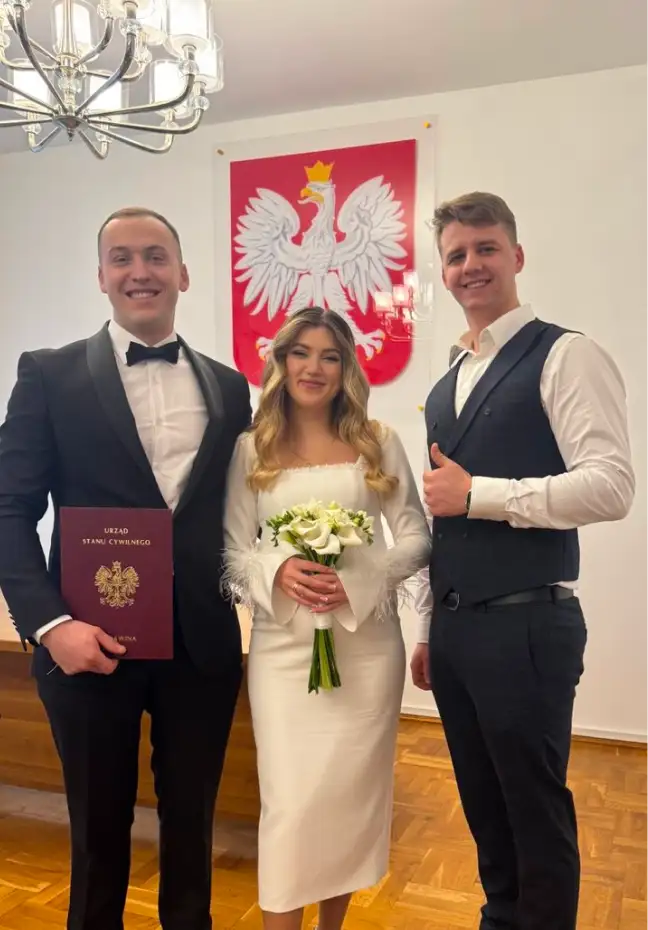
Warsaw carried out the first official transcription of a marriage certificate for two men wed in Germany — in compliance with rulings from Poland’s Supreme Administrative Court and the Court of Justice of the EU. This doesn’t mean the system has opened up for everyone automatically. But it does mean the precedent exists — and it matters.
Practical takeaways:
- If a marriage was registered in an EU country where it’s legal, there are grounds to attempt transcription in Poland
- The outcome depends on the specific voivodeship, the USC office, and the circumstances of the case
- Every situation requires individual assessment
- A refusal from USC can be challenged in court — and judicial practice is developing

Three Real Strategies for a Couple Living in Poland
Strategy 1: Register a marriage online through the USA
The state of Utah allows same-sex couples to register their marriage online as foreigners. The procedure takes 1-2 weeks, requires minimal documents, and happens entirely online. More details in our article Same-sex marriage online through the USA.
Strategy 2: Get married in an EU country where marriage is legal
The Netherlands, Belgium, Spain, Portugal, and other countries register marriages for foreign nationals. After registration — attempt transcription in Poland or use the document in the country where you plan to live.
Strategy 3: Relocate to a country where the relationship will be fully recognised
For some couples, the best solution is to live somewhere the law is on their side. Germany, the Netherlands, Spain, Portugal, and Austria are popular destinations among Ukrainians and Belarusians.
What Legalisation Actually Gives You
- Right to residency — a foreign partner gains the right to live in the country of the other partner’s citizenship or residency
- Inheritance rights — automatically, without a separate will
- Medical decision-making — the right to make decisions in critical situations
- Shared property — legal framework for joint ownership
- Tax benefits — in most countries, spouses have tax advantages
- Social benefits — entitlement to benefits in the event of a partner’s death
- Adoption — in countries where this is permitted for same-sex couples
Practical Steps: Where to Begin
- Clarify your situation — citizenships of both partners, country of residence, previous marriages, future plans
- Define your goal — do you need a personal document, residency rights, or relocation to a specific country?
- Evaluate your options — online through the USA, registration in an EU country, attempt transcription in Poland
- Consult a specialist — this saves time and gives a clear understanding of what’s actually possible in your specific case
- Take action — VisaV.pl supports you at every step