Humanitarian visa D21 is one of those topics where the internet is full of outdated advice, half-truths, and mixed-up concepts. Some call it a “protective visa,” others confuse it with international protection, some believe it automatically grants full access to employment, and others treat it as a universal solution for any foreigner who wants to stay in Poland. In reality, the situation is much more nuanced.
Simply put, D21 is a Polish national visa issued on humanitarian grounds, in view of the interests of the state or international obligations. It belongs to the category of national type D visas and, according to the official definitions of voivodeship offices, is issued for a period of up to 1 year.
In this article, we will examine the topic in depth and without myths: what D21 is, who it may be suitable for, how it is obtained, why the issue of “extension” is often framed incorrectly, whether you can work on this visa, what is available to citizens of Belarus and what is not, and how not to lose your legal status because of false expectations.
What the Humanitarian Visa D21 Actually Is
The designation D21 is used for a national visa issued for entry on humanitarian grounds, in view of the interests of the state or international obligations. In Polish government materials, this is directly linked to Article 60(1)(23) of the Foreigners Act. That is why D21 is not a separate “social benefit” and not a form of international protection, but a specific type of visa with a distinct legal basis for issuance.
It is very important here not to confuse three different things. The first is the D21 visa itself. The second is a temporary residence permit for citizens of Belarus who are already in Poland on the basis of a valid D21. The third is zgoda na pobyt ze względów humanitarnych, which is granted by the Border Guard. These are not the same thing, and for legalization practice, this distinction is of fundamental importance.
Who the Humanitarian Visa D21 May Be Suitable For
In practice, the topic of D21 is most often associated with citizens of Belarus, because Poland has a separate simplified logic of further legalization specifically for them after entry on such a visa. For citizens of other countries, the theoretical possibility of a humanitarian visa exists, but the procedure does not have the same separate and stable mechanism as it does for Belarusians. This means that in one case D21 may be a real path, while in another it may be only an attractive idea with no practical result.
It is also important to speak separately about citizens of Ukraine. If a person has access to the mechanisms of temporary protection or other special solutions for Ukrainians, the humanitarian visa D21 is usually not the first or most obvious instrument. In other words, the topic of D21 itself is not forbidden for Ukrainians, but in real practice it must always be compared with other grounds of stay rather than treated as the “main default option.”
Does D21 Give the Right to Work in Poland
This is where one of the most dangerous traps lies. After the changes effective from June 1, 2025, the mere fact of holding a certain visa no longer automatically means the right to work without an additional legal basis. Official explanations state directly that a foreigner may work if they have a proper basis of stay and also have a work permit or an oświadczenie, if these are required. The list of visas under which employment may be legalized, provided there is such an additional basis, includes visas issued for purposes 17–21. This means that today D21 should not be presented as a “visa with automatic free access to the labor market.”
In other words, the D21 visa itself may be a valid basis of stay, but the issue of employment must be checked separately. If a person belongs to a category exempt from the work permit requirement, that is one situation. If not, a separate document legalizing employment may be required. That is why old texts claiming that “with D21 you can work like a Polish citizen” can no longer be accepted uncritically in 2026.
For How Long the Humanitarian Visa D21 Is Issued
In voivodeship and migration information resources, D21 is described as a national visa issued for a period of up to 1 year. This is convenient for a longer lawful stay in Poland than a short-term visa, but it does not mean that it should be treated as a long-term solution “for several years.” On the contrary, D21 should often be viewed as a starting instrument after which it is necessary to decide which residence-based path is the right one going forward.
How to Obtain the Humanitarian Visa D21
In practice, applications for a national D visa are submitted through visa centers or consular mechanisms determined by the specific Polish authority. For Belarus, the official page of the Polish diplomatic service states that appointments are made through electronic registration, and in some cases the application may be submitted in person or by correspondence, depending on the chosen route.
Basic Set of Documents
For a national type D visa, the following are officially required: a completed and signed visa application form, a color photograph measuring 3.5 × 4.5 cm, a valid passport, a copy of the passport page containing personal data, medical insurance, a document confirming legal residence within the consular district, proof of sufficient financial means, proof of accommodation, and documents confirming the purpose of stay. For minors, additional documents are required, including notarized parental consent.
It must also be understood that in humanitarian cases, the key role is played not only by the technical document package but also by the justification of the purpose itself. In other words, it is not enough simply to submit an application form and a photo — the content of the case must be built in such a way that the consul does not get the impression that the person is trying to use D21 as a “workaround” instead of another, more obvious legal basis.

Processing Times
According to official information for the national visa, a decision is usually made within 15 working days from the date of payment. If a more detailed document review is required, the period may be extended to 30 days, and in urgent and justified cases, a decision may be made within 3 working days. These are the official timeframes, but in real practice additional time for booking, package revisions, and logistics should also be taken into account.
Can You Apply for D21 While Already in Poland
This question is most often asked in the context of citizens of Belarus. An official statement from the Ministry of Foreign Affairs confirmed a special possibility to submit applications in Poland for national visas for certain categories of foreigners, including citizens of Belarus applying specifically for visas on the humanitarian basis under Article 60(1)(23). That statement also referred to Belarusians who, on the date of filing, were already legally present in Poland on the basis of previously issued national visas under the same humanitarian status. However, such mechanisms have time limits and are tied to specific regulations, so the current filing regime at the moment of application must always be checked separately.
That is why the answer “yes, you can” or “no, you cannot” without clarifying the date, the nationality, and the person’s current status is too superficial. In D21 cases, details matter.
Can the Humanitarian Visa D21 Be Extended in Poland
Theoretically, extending a national visa in Poland is possible, but this is not a “standard technical service” — it is an exceptional procedure. Voivodeship offices state clearly that a wiza krajowa can be extended only once, and only if several conditions are met simultaneously: there is an important personal or professional interest or a humanitarian reason that prevents departure; these circumstances arose independently of the foreigner’s will and could not have been foreseen at the time of the visa application; the purpose of stay has not changed; and there are no grounds for refusal to issue the visa. The total period of stay on the basis of an extended national visa cannot exceed 365 days.
In practice, this means one very important thing: “I want to stay longer” is not a sufficient basis for extending D21. Extending a national visa is not an alternative to a normal residence permit procedure. If a person’s situation has already matured into the need for a longer stay in Poland, it is often necessary not to “stretch the visa,” but to move to the proper residence permit.
What Are the Deadline and Conditions for Applying for a Visa Extension
An application to extend a national visa must be submitted to the voivode responsible for the place of stay no later than the last day of lawful stay in Poland. If the deadline is met and there are no formal deficiencies, a stamp confirming the filing of the application is placed in the passport. The document package includes, among other things, the application, a photograph, a valid passport, documents confirming the reasons for the extension, the purpose and conditions of further stay, proof of funds, insurance, and payment of the fee. In the Podlaskie Voivodeship, the official fee indicated is 406 PLN, and the processing time is up to one month.
What Is Especially Important for Citizens of Belarus
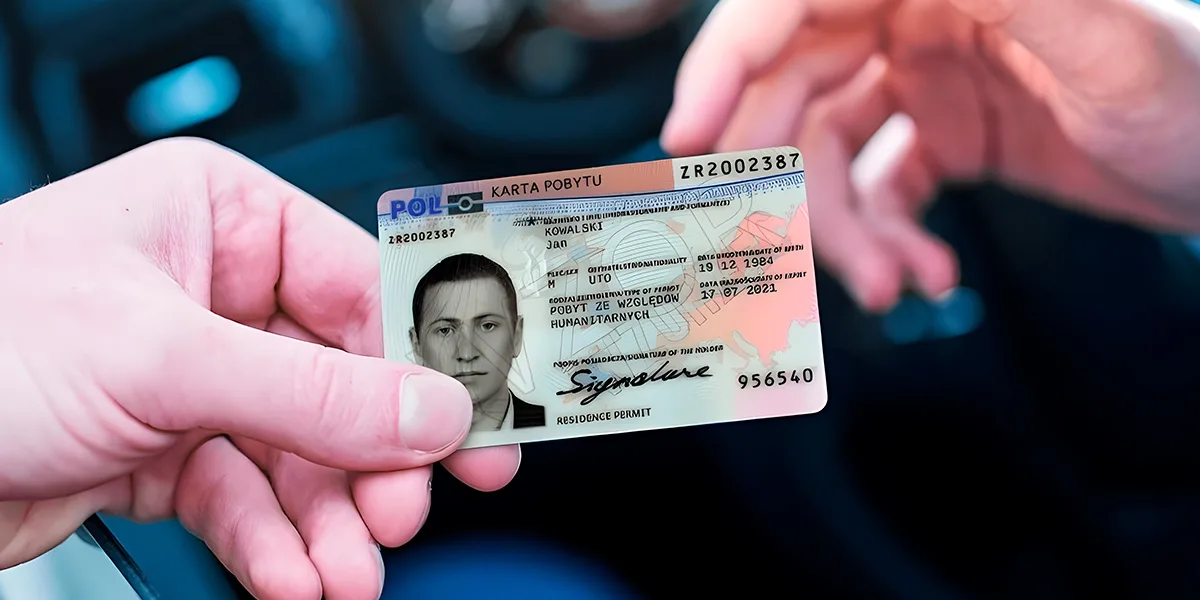
It is specifically for citizens of Belarus that a separate simplified path exists in Poland: if a person is staying in Poland on the basis of a valid D21 visa immediately before filing the application, they may apply for a special temporary residence permit on humanitarian grounds. Such a permit is granted once for 3 years, is exempt from stamp duty, and also does not require payment for the issuance of the residence card. Its holder is exempt from the obligation to have a work permit and, since January 1, 2023, may also apply for a Polish travel document for a foreigner.
This is one of the strongest practical answers to the question of “extending” D21. For Belarusians, in many cases it is more correct not to cling to the idea of extending the visa itself, but to switch in time to this three-year residence permit. It is this permit that provides a much more stable basis for life, work, and further planning of legalization in Poland.
Can Family Members Legalize Their Stay Together
Voivodeship explanations state directly that if a foreigner obtains a temporary permit due to having D21, their husband or wife may apply for a permit “due to other circumstances.” However, such a permit for a family member does not give the right to work without a separate work permit. That is why in family cases the rights of the main applicant cannot automatically be transferred to all other family members.
Can You Obtain a Polish Travel Document
For persons who have received a special temporary permit in connection with D21, there is a possibility to apply for a Polish travel document for a foreigner. Government explanations for Belarusians explicitly mention this option from January 1, 2023. This is especially important in situations where problems arise with the national passport or its renewal.
When D21 Is Not the Best Solution
Not every difficult life situation should be “packaged” specifically as a humanitarian visa case. If a person has another real and stronger basis for legalization — for example, work, studies, a Pole’s Card, or another obvious route — trying to force the case through D21 may create more questions than advantages. In humanitarian matters, excessive creativity often does more harm than good.
It is also worth remembering travel back to the country from which the person claims risks. Formally, the D21 visa itself does not “block departure,” but such trips may look contradictory in the context of further legalization if the logic of the humanitarian grounds ceases to appear convincing afterwards. This is not an automatic refusal, but it is definitely not a minor detail.
Step-by-Step Action Plan if You Need D21 or Its “Extension”
- First, determine whether D21 is truly the right basis for you, and not simply the “best-known” one.
- Separately check whether your situation concerns a visa procedure or already a residence-based procedure.
- Prepare not only the application form and photo, but also a strong logic of the case.
- Do not plan employment based on the myth that D21 automatically allows everything.
- If you are already in Poland, do not reduce everything to the question “can the visa be extended” — check whether it is already time to move to a residence permit.
- If you are a citizen of Belarus on a valid D21, assess the three-year residence permit as the priority scenario.