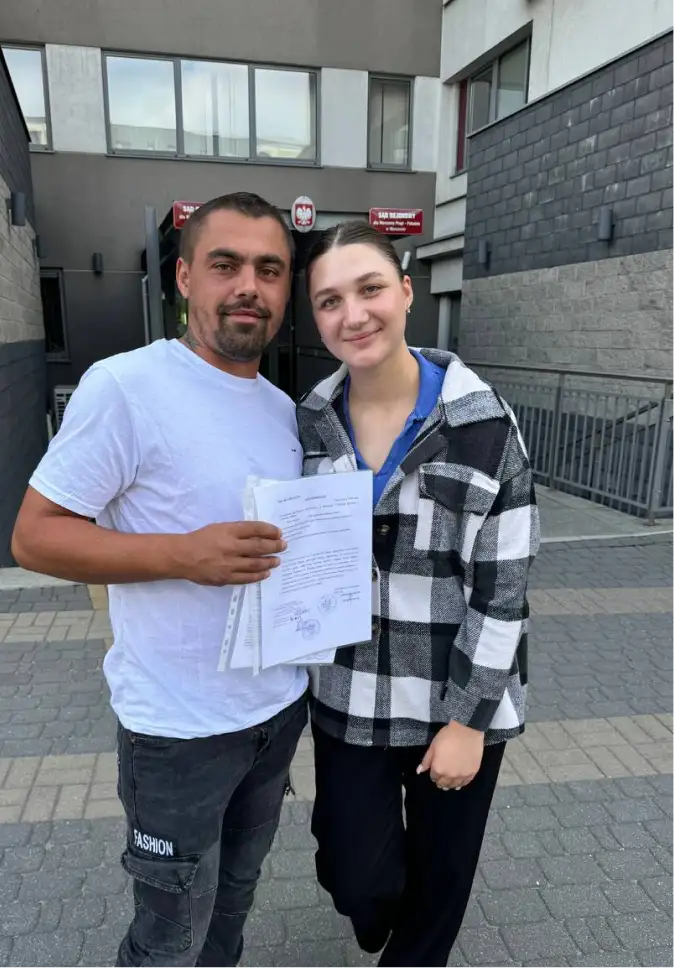
Not all couples in Poland are officially married. Some have been living together for a long time, share a household, rent accommodation, and plan their future, but have not yet registered a marriage in Poland. In such situations, a practical question often arises: is it possible to legalize your stay in Poland on the basis of cohabitation with your partner? The short answer is yes, in many cases it is possible, but this type of case requires very careful preparation.
In the Polish system, this is usually not a separate “residence card for cohabiting partners” explicitly named in the law, but rather a temporary residence procedure based on other circumstances. That is exactly why it is especially important here not just to collect a basic set of documents, but to convincingly show that your relationship is genuine, that your shared life is not merely a formality, and that your stay in Poland for more than 3 months is truly justified.
Below, we will explain the key points: who can apply for a residence card on the basis of actual cohabitation, which evidence matters most, what documents to prepare, whether you can work with such a card, and when it is better to build a different legalization strategy from the start.
What Is Considered Cohabitation in the Context of a Residence Card
This refers to a genuine informal relationship in which a couple lives together, shares a household, and can prove it with documents. Polish official resources clearly indicate that this concerns being in a związek nieformalny or związek niesformalizowany with a Polish citizen or a foreigner who has a legal basis to stay in Poland.
For this type of case, it is not enough simply to say that you are “dating.” The authority will look at whether there are real signs of a shared life, not just personal statements.
- living together at the same address;
- sharing a household;
- the duration and stability of the relationship;
- financial or housing ties;
- documents and materials confirming all of the above.
Who Can Apply for a Residence Card Based on Cohabitation
A foreigner who plans to stay in Poland for more than 3 months and is in an informal relationship with one of the following may apply:
- a Polish citizen;
- a foreigner who has a lawful basis for staying in Poland.
Official explanations directly confirm this. At the same time, it is important that the circumstances of the cohabitation genuinely justify a longer stay in Poland. This means that the case must be real-life, logical, and supported by evidence.
When This Basis May Be Suitable
- you genuinely live together in Poland;
- your partner is staying here legally;
- you can demonstrate a shared household;
- you have documents confirming your relationship and cohabitation;
- your situation does not look like a formal scheme created “just for the card.”
When You Should Be Careful
- you have almost no joint evidence;
- the relationship is very new and unsupported by documents;
- you do not actually live together;
- your main real purpose is work, business, or study rather than cohabitation;
- there are inconsistencies between the documents and the actual circumstances of the case.
What Legal Basis Is Used for a Residence Card Based on Cohabitation
Such a case is usually considered as temporary residence based on other circumstances. That is why there is no automatic approval here, even though people sometimes expect it. The authority evaluates not only the set of documents, but also whether the need for a longer stay in Poland on this exact basis has been convincingly justified. Official MOS information directly points to this route for partners in informal relationships.
- this is not a classic “family residence card” through an official marriage;
- the case is assessed individually;
- the evidentiary basis is of great importance;
- the logic of the stay must be clear;
- a formal package without strong substance rarely works well here.

What Documents Are Usually Required
The exact list may vary depending on the situation, but official sources indicate a standard set of documents for cases of this type. In particular, you will need the applicant’s documents, the partner’s documents, proof of cohabitation, insurance, accommodation, and financial documentation.
Basic Package
- a completed application for temporary residence;
- current photographs;
- a copy of a valid passport;
- proof of payment of the fee;
- insurance;
- proof of accommodation;
- proof of stable and regular income.
Additional Documents Relating to the Partner
- a copy of the partner’s passport or other identity document;
- a document confirming the partner’s legal status in Poland, if they are not a Polish citizen;
- a statement from the partner confirming cohabitation or family life together;
- documents confirming your relationship and shared household.
How to Prove That the Relationship Is Genuine
This section is often decisive. In an official marriage, the key proof is a civil status record, but in cohabitation cases you need to build an evidentiary basis from different sources. The more logical and consistent the evidence is, the stronger the case appears.
What Can Strengthen the Case
- a joint rental agreement or other housing-related documents;
- joint address registration;
- joint bills, transfers, and household expenses;
- correspondence or other materials showing the stability of the relationship;
- joint photographs from different periods of time;
- documents showing that you genuinely share a life together.
What Weakens the Case
- no shared address;
- very few documents and mostly “verbal explanations”;
- major inconsistencies between your statements;
- a very recent relationship with no household-related evidence;
- an attempt to replace documents with photographs alone.
How to Prove Income and Financial Support
The financial side of such cases is no less important than the relationship itself. The authority must see that your stay in Poland is not “detached from reality” and that you have the means to support yourself.
In practice, they look at:
- the source of stable income;
- the regularity of that income;
- the ability to support the applicant;
- the overall financial logic of the household.
If the applicant has no income of their own, the focus may sometimes shift to the partner’s financial capacity. But this must be presented clearly and convincingly, not superficially. A weak explanation of the financial side often undermines even a fairly good relationship-based case.
Can You Work with This Type of Residence Card
There is an important nuance here. Official sources indicate that a temporary residence permit based on other circumstances does not automatically grant the right to work without a work permit. This is one of the most important points that is often overlooked in short articles on this topic.
- such a card in itself does not automatically mean “access to the labor market”;
- in many cases, a separate lawful basis is required in order to work;
- if your real goal is employment, the basis for your application must be chosen very carefully;
- if your life situation changes, it may become necessary to change the basis of your stay.
What Proper Case Preparation Looks Like
A strong cohabitation application is always the result of a systematic approach. It does not come down to a few photographs and a short statement from your partner. A step-by-step method works best.
- Assess whether this basis is truly right for you.
- Verify your partner’s legal status.
- Collect evidence of shared residence and household life.
- Prepare the financial part of the case.
- Put together a logical package of documents with no contradictions.
- Explain the circumstances in a way that makes the case look complete and natural.
It is at this stage that people most often realize that preparing everything “just by following a checklist” is not enough. What matters here is not only having documents, but also presenting the entire story of the case correctly.
Typical Mistakes When Applying on the Basis of Cohabitation
Most refusals or difficult requests do not arise by chance. They are usually connected with common weak points.
- the chosen basis does not match the real purpose of the stay;
- there is too little evidence of the relationship, or it is too superficial;
- there is no convincing proof of living together;
- the income is described vaguely or supported weakly;
- there are contradictions in the documents;
- people assume that “it’s obvious we’re a couple anyway.”
When It Is Better Not to Risk Applying on Your Own
There are categories of cases where it is better to involve professional support from the outset. This is especially relevant when the situation is non-standard or when you can already see gaps in your evidentiary basis.
- if you have very few joint documents;
- if your partner is a foreigner with a complicated status;
- if you have had previous refusals or problems with legalization in Poland;
- if you are also planning to work and are afraid of choosing the wrong basis;
- if your case requires not a standard filing, but a genuinely well-thought-out strategy.
Legal Support in Cohabitation Cases
In these cases, people make mistakes not because they “didn’t read the document checklist,” but because they underestimated the complexity of the logic of proof itself. That is exactly where help is needed — not formal help, but practical assistance.
- we assess whether cohabitation is the right basis for you;
- we advise which evidence will genuinely strengthen your case;
- we help structure the logic of your document package;
- we draw attention to risks that are often not obvious at the beginning;
- we support the process so that you do not waste time on chaotic steps and unnecessary mistakes.
If you want to go through the process calmly, without unnecessary bureaucracy and without the constant fear that your case looks “weak,” the best approach is not to wait until you receive a problematic letter from the immigration office, but to prepare everything properly from the very beginning.